Think you can save money by paying your employees as 1099 contractors?
That decision could end up costing your business far more than you save.
For small-business owners, labor is often one of the largest expenses. Between payroll taxes, workers' compensation insurance, unemployment taxes, and employee benefits, hiring employees can get expensive.
It's understandable why some business owners prefer to pay workers as independent contractors. After all, 1099 contractors generally don't require the business to withhold payroll taxes, pay the employer's share of Social Security and Medicare, or provide traditional employee benefits.
But here's what many business owners don't realize:
You don't get to choose whether someone is a 1099 contractor or a W-2 employee simply because it's cheaper or more convenient.
The IRS has specific guidelines for determining worker classification, and getting it wrong can lead to back taxes, penalties, interest, and other potentially costly consequences.
What Is the Difference Between a 1099 Contractor and a W-2 Employee?
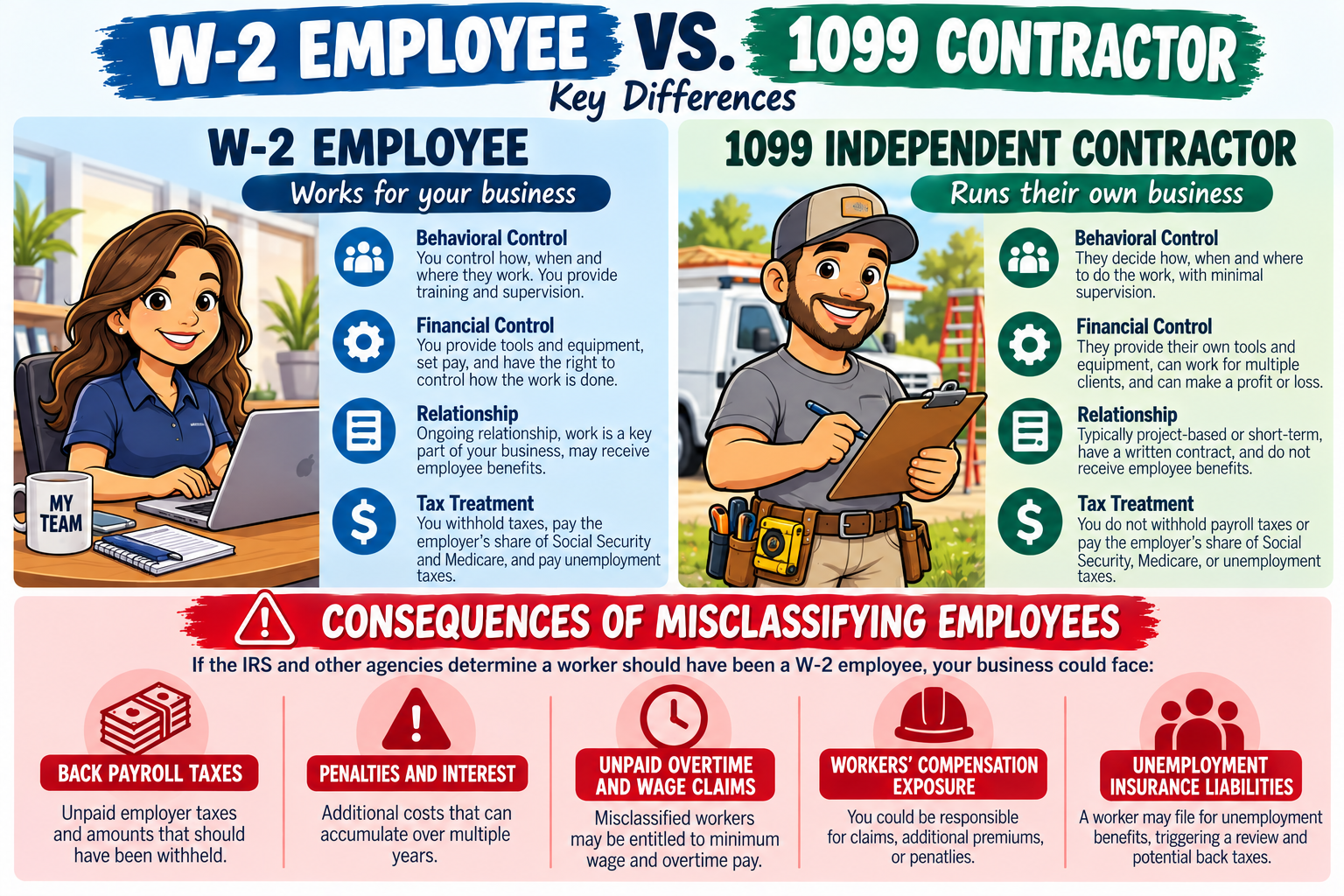
A W-2 employee works for a business that generally has the right to control both the work performed and how that work is performed.
An independent contractor, commonly referred to as a 1099 worker, is generally in business for themselves and maintains greater independence over how they complete their work.
For federal employment-tax purposes, the IRS examines three main factors:
1. Behavioral Control: Who Controls the Work?
Does your business determine how, when, and where the person works?
Consider these questions:
-
Do you set the worker's schedule?
-
Do you provide instructions on how to complete their job?
-
Do you train the worker to follow your company's procedures?
-
Do you supervise how the work is performed?
-
Do you require the worker to follow specific methods or processes?
The more control your business has over how the work is performed, the more likely the individual may be considered an employee.
Example: You hire someone to work in your office Monday through Friday, 9 a.m. to 5 p.m. You assign their daily responsibilities, supervise their work, and require them to follow your company's procedures.
Calling that person an independent contractor doesn't necessarily make them one.
2. Financial Control: Who Controls the Business Side?
The IRS also looks at the financial relationship.
-
Does the worker provide their own equipment and tools?
-
Can they work for other companies?
-
Do they advertise their services to the public?
-
Can they make a profit or suffer a financial loss?
-
Do they have significant business expenses or investments?
-
Are they operating an independent business?
For example, a plumber who owns a plumbing company, supplies their own tools, works for numerous customers, and invoices your business for a specific project is more likely to qualify as an independent contractor.
However, a plumber who works exclusively for your business, follows your daily schedule, and uses your equipment may have characteristics of an employee.
3. Relationship: What Is the Nature of the Working Arrangement?
The IRS also considers the relationship between the business and the worker.
Questions include:
-
Is there a written independent contractor agreement?
-
Is the relationship ongoing or project-based?
-
Does the worker receive employee-type benefits?
-
Is the work a key part of the company's regular business?
Important: A signed independent contractor agreement does not automatically establish independent contractor status.
The IRS looks at the actual working relationship, not just what the paperwork says. No single factor automatically determines the answer.
What Happens If You Misclassify an Employee?
This is where an attempt to reduce payroll expenses can become a very expensive mistake.
If the IRS determines that workers you paid as independent contractors should have been classified as employees, your business could face several consequences.
1. Back Payroll Taxes
You may be responsible for unpaid employer payroll taxes, including Social Security, Medicare, and applicable federal unemployment taxes, as well as amounts that should have been withheld from employee wages. Special reduced-rate or relief provisions may apply in certain circumstances.
2. Penalties and Interest
Depending on the circumstances, the IRS may assess penalties and interest on unpaid taxes. These amounts can accumulate over multiple tax years.
3. Unpaid Overtime and Wage Claims
Misclassified workers may be entitled to minimum wage and overtime protections under applicable labor laws.
Imagine paying someone a flat weekly amount as a contractor, only to discover later that they legally qualified as an employee entitled to overtime compensation.
4. Workers' Compensation Exposure
This is a particularly serious concern in industries such as construction, roofing, landscaping, manufacturing, and transportation.
If a worker is injured on the job and is determined to be an employee rather than an independent contractor, the business could face workers' compensation liabilities, additional premiums, or penalties, depending on state law and the circumstances.
An uninsured subcontractor can also create additional workers' compensation premium exposure during an insurance audit, even when the worker's classification is not disputed.
5. Unemployment Insurance Liabilities
A misclassified worker who loses their job may file for unemployment benefits. That claim could prompt a review of whether the individual was actually an employee, potentially leading to unpaid unemployment taxes and other assessments.
And remember, an IRS determination is not the only concern. State labor departments, unemployment agencies, and workers' compensation regulators may apply their own classification rules.
How Does the IRS Find Out About Misclassified Employees?
Many business owners assume the IRS would have no reason to question how they classify workers unless their company is already being audited.
That's not necessarily true.
Worker classification concerns can surface in several ways.
1. A Worker Questions Their Classification
One of the most direct ways is through the worker.
An individual who believes they have been incorrectly classified can submit IRS Form SS-8, requesting a determination of whether they are an employee or independent contractor.
The IRS can review the working relationship and contact the business for additional information.
2. An Unemployment Claim
Imagine a contractor who worked for your business for two years and then loses their position.
They apply for unemployment benefits, only to discover that your business never paid unemployment taxes on their wages.
The state may investigate whether they were actually an employee. State and federal agencies can share certain tax and employment information.
3. A Workplace Injury
A worker gets injured and discovers there is no workers' compensation coverage available to them as a contractor.
That injury may lead to an investigation by an insurer or state agency into whether the person should have been treated as an employee.
4. Tax Return Discrepancies
The IRS receives information from Forms 1099, W-2, and business tax returns.
The agency uses computerized screening and information matching to identify potential tax-reporting problems.
A large amount of contractor compensation or other unusual reporting patterns could raise questions during a review, although paying substantial legitimate contractor expenses is not itself proof of misclassification.
5. Complaints or Investigations by Other Agencies
The IRS shares certain information with state tax authorities and workforce agencies. It also has arrangements for employment-tax referrals with the U.S. Department of Labor.
A labor-law investigation can therefore expose a possible employment-tax classification problem.
The bottom line? A business doesn't necessarily have to be selected for a random IRS audit for a classification problem to come to light.
Five Common Misconceptions About 1099 Workers
"They agreed to be a 1099 contractor."
An employee cannot simply sign away their legal classification.
"They only work part-time."
Part-time workers can still be W-2 employees. The number of hours worked does not determine classification by itself.
"I pay them by the job instead of hourly."
Payment methods are relevant but do not independently determine whether someone is a contractor.
"They have their own LLC."
Having an LLC or business name does not automatically make someone an independent contractor. The actual working relationship still matters.
"Everyone in my industry pays workers as 1099s."
A common industry practice doesn't necessarily make that practice compliant.
How Can a PEO Help Small Businesses Avoid HR and Payroll Problems?
Many small-business owners aren't intentionally trying to break the rules. They're trying to operate their businesses without the expense of hiring an entire human resources and payroll department.
Unfortunately, employment laws can be complicated, and mistakes can become costly.
That's where a Professional Employer Organization (PEO) can be valuable.
Depending on the provider and service agreement, a PEO can help businesses with:
-
Payroll processing: Calculating wages, processing payroll, and handling associated payroll-tax filings and deposits.
-
Workers' compensation: Providing access to workers' compensation coverage through payroll, often on a pay-as-you-go basis.
-
HR guidance: Helping business owners understand employment practices, worker classification concerns, hiring, terminations, and compliance obligations.
-
Employee onboarding: Establishing consistent processes for bringing employees into the business.
-
Employment administration: Helping organize payroll records, employee documentation, and other administrative responsibilities.
Instead of trying to manage everything themselves, small-business owners can access professional HR support without necessarily hiring a full-time HR professional.
A PEO cannot simply turn someone into a properly classified employee by processing their payroll, and it does not eliminate the business owner's legal responsibilities. However, a knowledgeable PEO can be a valuable resource for identifying potential issues and helping establish appropriate employment practices.
The Cheapest Payroll Solution Isn't Always the Least Expensive
Paying workers as 1099 contractors may appear to save money today.
But if those workers should legally be employees, the long-term financial exposure could far outweigh the initial savings.
Back taxes, penalties, workers' compensation liabilities, and wage claims can quickly become a significant financial burden.
Before deciding whether someone should be paid as a 1099 contractor or W-2 employee, make sure you understand the rules.
If you are unsure, you can request a formal worker-status determination from the IRS using Form SS-8 or consult a qualified employment or tax professional.
The IRS also offers a Voluntary Classification Settlement Program for certain eligible businesses that want to begin treating previously classified contractors as employees.
Need Affordable Payroll, Workers' Compensation, and HR Help?
At PEO Depot, we help small businesses explore PEO solutions designed to simplify payroll, workers' compensation, and human resources.
We work with multiple PEO providers to help match businesses with programs that fit their industry, size, and specific needs.
Whether you're struggling with payroll administration, workers' compensation costs, or HR questions, we can help you explore your options.
Don't wait until an employment mistake turns into an expensive problem.
Visit www.peodepot.com to learn how a PEO may help your business.
Disclaimer: This article provides general educational information and is not legal or tax advice. Worker classification requirements vary by law and jurisdiction. Consult a qualified professional for guidance on your particular circumstances.