Can Independent Contractors Change My Workers’ Compensation Requirement?
Many business owners believe that if they pay someone as a 1099 independent contractor or subcontractor, that person has nothing to do with their workers’ compensation policy.
That assumption can lead to a very expensive surprise.
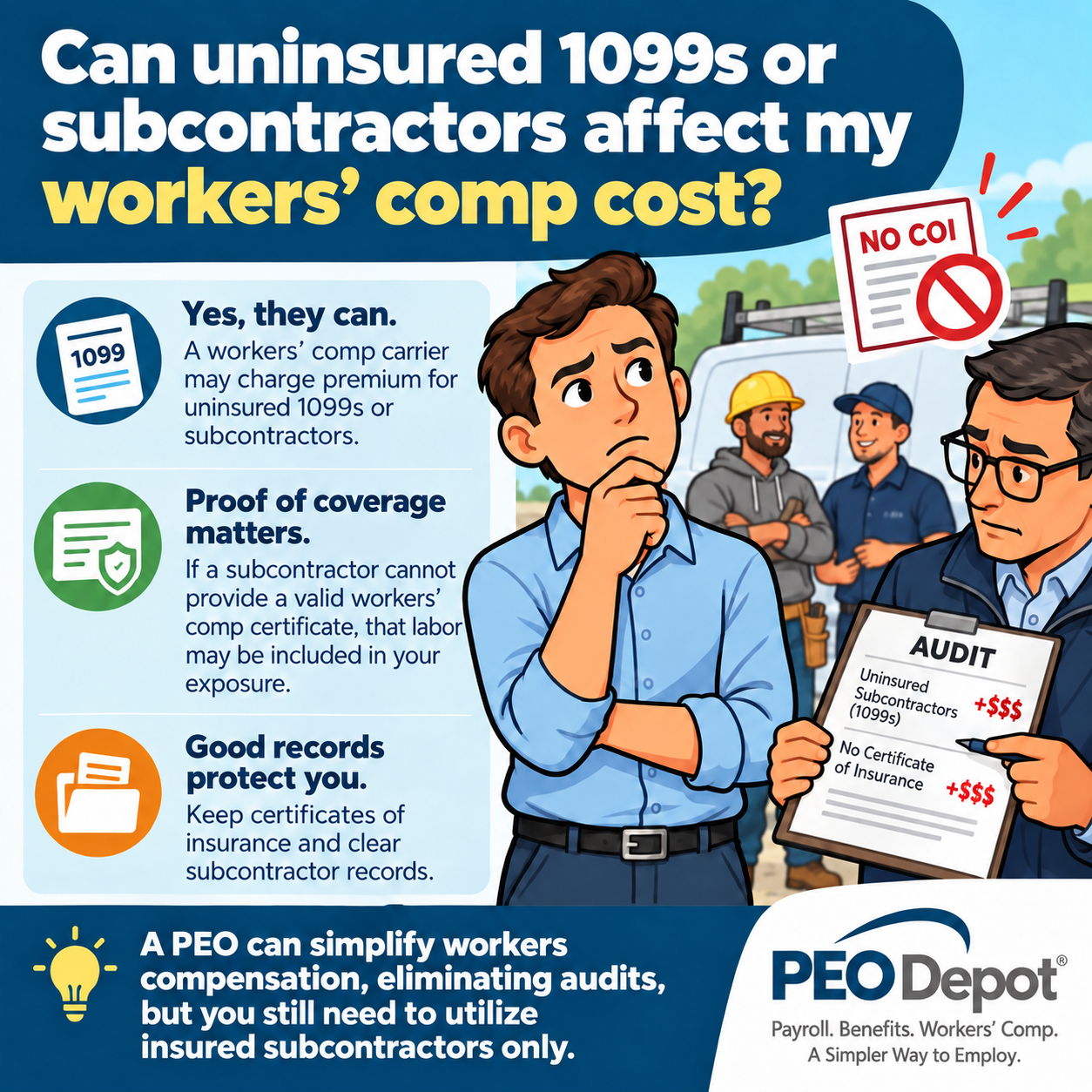
The Problem: Uninsured Subcontractors Can Affect Your Workers’ Comp Premium
When your traditional workers’ compensation policy is audited, the insurance carrier may review more than just your employee payroll.
They may also review:
-
Payments made to 1099 contractors
-
Payments made to subcontractors
-
Check registers and disbursement records
-
Certificates of Insurance for subcontractors
If a contractor or subcontractor cannot provide proof that they maintained their own workers’ compensation coverage while working for you, the carrier may treat that work as additional workers’ compensation exposure and charge additional premium.
In other words:
Writing someone a 1099 does not automatically keep their labor off your workers’ compensation audit.
Why Certificates of Insurance Matter
One of the best ways to protect your business is to require subcontractors to provide a valid Certificate of Insurance (COI) showing workers’ compensation coverage.
The certificate should cover the entire period during which the subcontractor performed work for your company.
Travelers specifically recommends maintaining certificates showing workers’ compensation coverage for independent contractors and subcontractors and notes that premium may be charged when valid proof of coverage is unavailable.
That means a good rule of thumb is:
If you are going to use subcontractors, use properly insured subcontractors and keep their certificates on file.
The Surprise Often Comes at Audit Time
This is where many business owners get caught off guard.
At the beginning of a traditional workers’ compensation policy, the premium is generally based on estimated exposure.
At the end of the policy period, the carrier conducts an audit to determine what actually happened during the year.
The audit can review payroll, classifications, subcontractors and other business activity. If the carrier finds uninsured subcontractor exposure, your final premium can increase.
So a business owner who thought:
“They were 1099s, so they weren't part of my workers’ comp.”
may suddenly receive an additional premium bill.
How a PEO Can Simplify Workers’ Compensation
This is one of the reasons a Professional Employer Organization, or PEO, can be an attractive alternative to a traditional workers’ compensation policy.
A PEO generally combines payroll processing and workers’ compensation into a pay-as-you-go program.
Instead of estimating your employee payroll for an entire year and then reconciling it through a traditional year-end premium audit, workers’ compensation charges are based on the actual employee payroll processed each pay period.
That can mean:
-
No large workers’ compensation premium deposit
-
Premium based on actual payroll
-
Better cash flow
-
Payroll administration included
-
Employment tax filings and deposits handled
-
No traditional year-end workers’ compensation premium audit in many PEO programs
For businesses that have experienced unpleasant audit surprises, that alone can be a major benefit.
But a PEO Doesn't Make Uninsured Subcontractors Okay
There is an important distinction.
Moving your employees into a PEO does not mean you should stop verifying your subcontractors.
Workers’ compensation through the PEO generally applies to the employees properly enrolled and reported through the PEO payroll.
If you are hiring independent contractors or subcontractors outside of that payroll, you should still make sure they are properly classified and appropriately insured.
A PEO can simplify workers’ compensation and eliminate the traditional premium audit — but you still need to utilize insured subcontractors only.
The Bottom Line
Independent contractors and subcontractors absolutely can affect your workers’ compensation costs.
The biggest mistake is assuming that paying someone on a 1099 automatically removes them from consideration.
If you use subcontractors:
Verify their coverage. Get the Certificate of Insurance. Keep it on file. Make sure it stays current.
And if you are tired of estimating payroll, large deposits and worrying about what your traditional workers’ compensation audit may uncover, it may be worth looking at a PEO.
At PEO Depot, we work with hundreds of workers’ compensation through payroll programs and help businesses find options based on their industry, payroll, claims history and individual circumstances.
Want to see if a PEO could simplify your workers’ compensation program? Contact PEO Depot and let us compare your options.
Workers’ compensation requirements and treatment of independent contractors vary by state and individual circumstances. Coverage and audit treatment should always be confirmed for your specific situation.