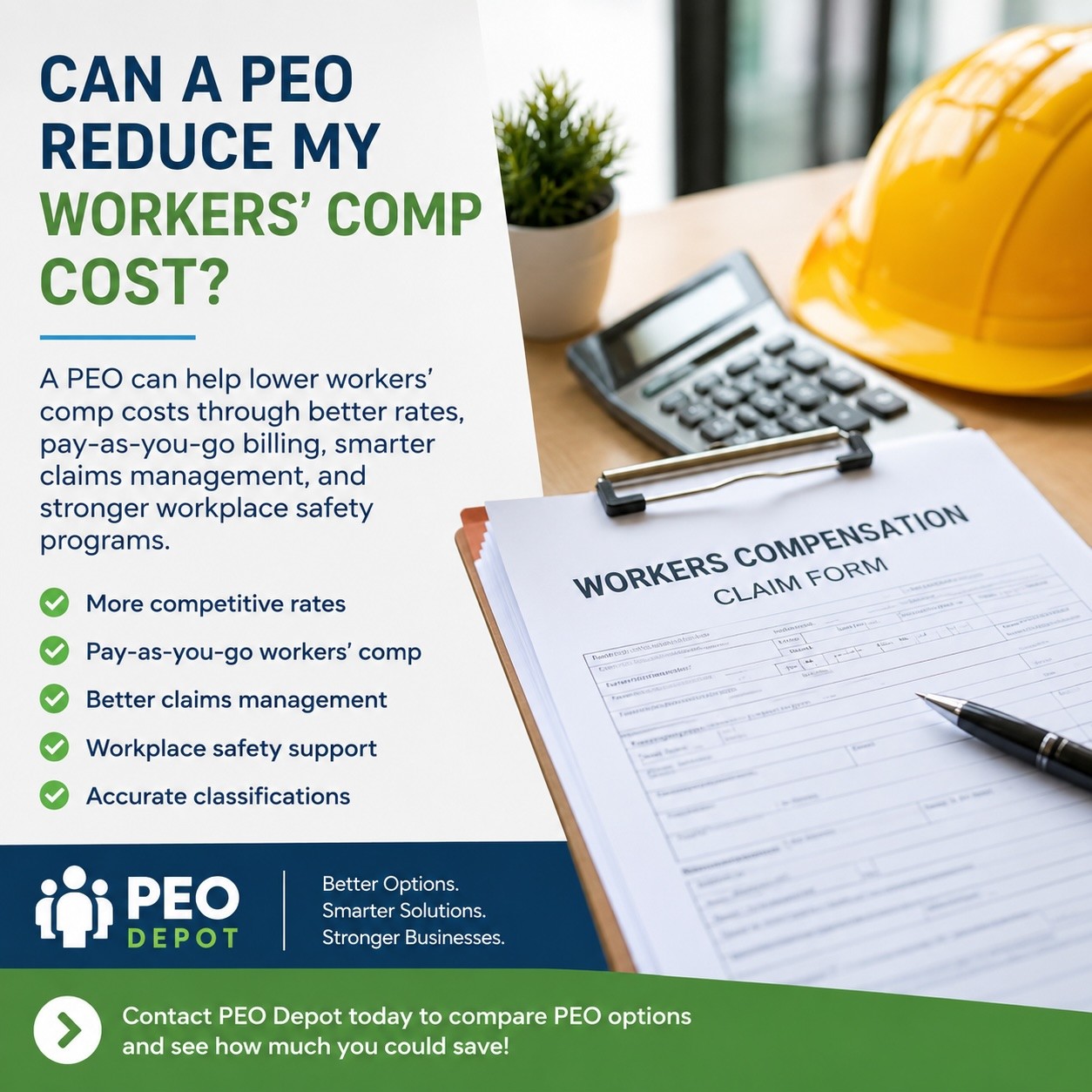
Can a PEO Reduce My Workers’ Comp Cost?
Workers’ compensation insurance is a necessary expense for most employers—but for businesses with rising premiums, difficult classifications, or a history of claims, it can become a significant burden.
That leads many business owners to ask:
Can a PEO reduce my workers’ comp cost?
The answer is yes, a Professional Employer Organization (PEO) may be able to lower your workers’ compensation costs—but the savings depend on your business, industry, claims history, location, and the PEO program available to you.
More importantly, a PEO can sometimes reduce more than just the insurance premium. It may also help businesses control claims, improve workplace safety, simplify administration, and make workers’ comp expenses easier to manage.
How Workers’ Compensation Costs Are Determined
Before looking at how a PEO can help, it is important to understand what drives workers’ compensation costs.
Your premium is generally influenced by factors such as:
-
Your total payroll
-
Employee job classifications
-
The type of work your employees perform
-
Your state and location
-
Your claims history
-
Your experience modification rate, when applicable
-
The insurance carrier’s rates and underwriting guidelines
Businesses in higher-risk industries—including construction, manufacturing, transportation, healthcare, landscaping, and certain skilled trades—can face especially high workers’ compensation costs.
A poor claims history can make obtaining affordable coverage even more challenging.
How Can a PEO Help Reduce Workers’ Comp Costs?
A PEO combines workers’ compensation with other employer services such as payroll, HR administration, employee benefits, and compliance support.
Depending on the PEO and the structure of its workers’ compensation program, there are several ways this relationship may help lower your overall costs.
1. Access to More Competitive Workers’ Comp Programs
PEOs work with many businesses and manage significant amounts of payroll. Because of that scale, some PEOs can offer access to workers’ compensation programs that may be more competitive than what an individual employer can obtain on its own.
This can be particularly valuable for businesses that have:
-
High workers’ comp premiums
-
Difficult-to-place classifications
-
Previous claims
-
Limited options in the traditional insurance market
-
Rapidly growing payroll
However, not every PEO will offer a lower workers’ comp rate. Comparing multiple PEO programs is critical.
2. Pay-As-You-Go Workers’ Compensation
Many PEO arrangements incorporate workers’ compensation costs directly into payroll.
Instead of estimating annual payroll, paying large deposits, and potentially facing a substantial premium audit adjustment later, workers’ comp charges can be calculated based on actual payroll as it is processed.
This can provide several advantages:
-
Better cash flow
-
Smaller upfront insurance deposits
-
More accurate premium calculations
-
Fewer surprises at year-end
-
Easier budgeting
For growing businesses or companies with seasonal payroll fluctuations, this structure can be especially helpful.
3. Better Claims Management
The cost of a workers’ compensation claim does not necessarily end when an employee reports an injury.
How quickly and effectively a claim is managed can have a major impact on its total cost.
Many PEOs provide claims-management support designed to help employers report injuries promptly, communicate with the appropriate parties, and manage return-to-work processes.
Better claims management can potentially reduce claim duration and limit the long-term impact that losses have on a company's workers’ compensation costs.
4. Workplace Safety and Risk Management
The least expensive workers’ compensation claim is the one that never happens.
PEOs often provide risk-management resources that can help employers identify workplace hazards and strengthen safety practices.
Depending on the PEO, these services may include:
-
Workplace safety reviews
-
Safety program development
-
Employee safety training
-
OSHA-related guidance
-
Accident investigation support
-
Return-to-work programs
-
Risk-management consultations
Reducing workplace injuries can have a long-term impact on workers’ compensation expenses, especially for employers with significant payroll in higher-risk job classifications.
5. More Accurate Employee Classifications
Workers’ compensation rates vary significantly depending on the work an employee performs.
Incorrect classification can cause an employer to pay too much—or create problems during an audit.
A PEO can help businesses review job duties, payroll information, and workers’ compensation classifications to improve administrative accuracy.
That does not mean employees can simply be moved into a cheaper classification. Classifications must accurately reflect the work being performed. But correcting legitimate errors can sometimes uncover unnecessary costs.
Can a PEO Help If I Have a High Experience Mod?
Possibly.
Businesses with an unfavorable loss history or a high experience modification factor can have difficulty finding competitive workers’ compensation coverage.
Some PEO programs may provide an alternative to a traditional standalone workers’ compensation policy.
Whether a particular PEO can accept your company—and whether the economics make sense—will depend on factors including:
This is one reason it can be valuable to compare multiple PEOs rather than approaching only one provider.
Each PEO has different underwriting guidelines and risk appetites. A business that is unattractive to one PEO may be a good fit for another.
Don't Look at the Workers’ Comp Rate Alone
A lower workers’ compensation rate sounds attractive, but it should not be the only number you evaluate when comparing a PEO.
PEO pricing can include costs for:
-
Workers’ compensation
-
Payroll administration
-
HR services
-
Employee benefits
-
Risk management
-
Compliance support
-
Administrative fees
A PEO might offer a lower workers’ comp rate but charge higher administrative fees. Another may have a slightly higher insurance cost but deliver a lower total employment cost.
The best comparison is based on the total cost of the PEO relationship, not one line item.
How Much Can a PEO Save on Workers’ Compensation?
There is no universal percentage.
Some businesses may see meaningful savings, while others may find that their current workers’ compensation program is already competitive.
The potential opportunity becomes clearer after reviewing information such as:
-
Current workers’ compensation rates
-
Payroll by class code
-
Experience modification rate
-
Loss runs
-
Current insurance premiums
-
Number of employees
-
Business locations
With this information, multiple PEO programs can be evaluated on an apples-to-apples basis.
Is Switching to a PEO Worth It Just for Workers’ Comp?
Sometimes—but workers’ compensation is usually only part of the equation.
A PEO may also help a business with:
For some companies, workers’ compensation savings are the primary reason they begin looking at PEOs. The broader HR and administrative support becomes an additional benefit.
For others, the workers’ comp rate may be similar to their current program, but savings in benefits, payroll administration, or internal HR expenses make the overall PEO relationship worthwhile.
The Bottom Line
Yes, a PEO can potentially reduce your workers’ compensation costs.
Savings may come through more competitive coverage, pay-as-you-go billing, improved claims management, stronger safety programs, and more efficient administration.
But PEO pricing and workers’ compensation programs vary significantly from one provider to another. The lowest workers’ comp rate does not necessarily mean the lowest total cost.
The best approach is to compare multiple PEOs using your company's actual payroll, employee classifications, claims history, and current costs.
At PEO Depot, we help businesses compare PEO options to identify providers that fit their industry, workforce, risk profile, and budget. Instead of contacting PEOs one at a time, businesses can evaluate multiple options and determine whether moving to a PEO could reduce workers’ comp costs—and their overall cost of employment.
Interested in finding out whether a PEO could lower your workers’ compensation costs? Contact PEO Depot to compare PEO options for your business.
Workers’ compensation availability, pricing, coverage, and requirements vary by state, insurance carrier, PEO, and employer risk profile.