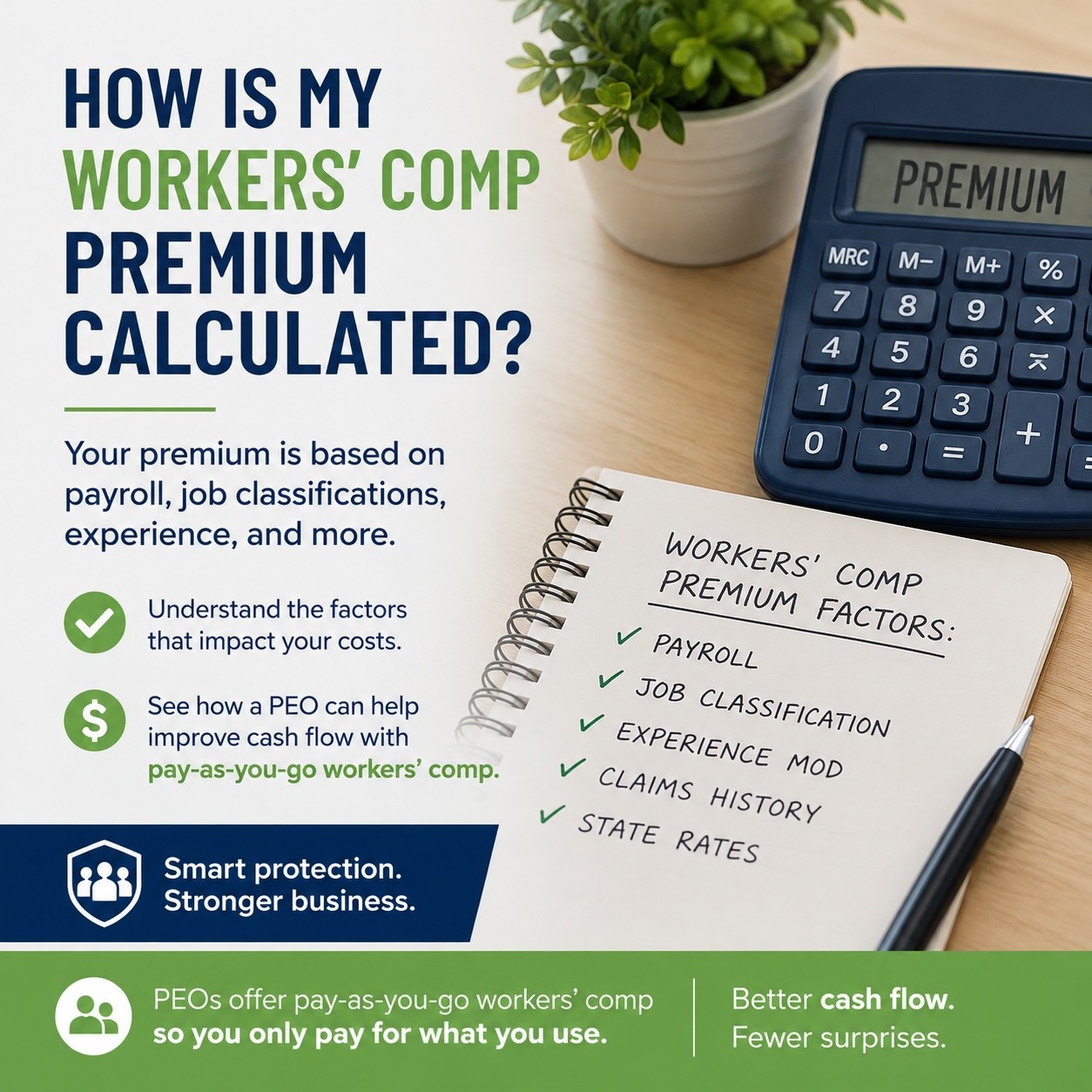
How Is My Workers’ Comp Premium Calculated?
Workers’ compensation insurance is an important part of protecting your employees and your business. But if you’ve ever looked at your workers’ comp bill and wondered, “Where did this number come from?” you’re not alone.
Workers’ compensation premiums aren’t typically based on one flat rate. Instead, insurers look at several factors, including your payroll, the type of work your employees perform, your claims history, and the workers’ comp rates that apply to your business.
Here’s a simple breakdown of how it works.
The Basic Workers’ Comp Premium Formula
At a high level, your workers’ compensation premium is generally calculated using this formula:
Payroll ÷ $100 × Workers’ Comp Rate = Estimated Premium
For example, suppose you have an employee classification with:
The calculation would look like this:
$500,000 ÷ $100 × $2.00 = $10,000
Your estimated workers’ compensation premium for that payroll classification would be $10,000 before any additional factors or adjustments are applied.
Sounds simple enough—but there’s more that goes into determining the final number.
1. Your Employees’ Classification Codes
One of the biggest factors affecting your workers’ comp premium is what your employees actually do.
Workers are assigned classification codes based on their job duties and the level of risk associated with their work.
For example, an office employee who spends most of the day at a desk generally presents a much lower workers’ compensation risk than a roofer, construction worker, or manufacturing employee.
Higher-risk jobs typically have higher workers’ comp rates.
This is why correctly classifying employees matters. Incorrect classifications can potentially result in inaccurate premiums, unexpected audit adjustments, or other issues.
2. Your Payroll
Workers’ compensation premiums are typically tied directly to payroll.
As payroll increases, your workers’ comp exposure generally increases as well.
When you purchase a traditional workers’ compensation policy, your insurer may ask you to estimate your payroll for the upcoming policy year. At the end of the policy period, an audit may compare your estimated payroll with your actual payroll.
If your actual payroll was higher than estimated, you could owe an additional premium.
If it was lower, you may be entitled to an adjustment or credit depending on the policy.
3. Your Workers’ Comp Rate
Each classification code has an associated workers’ compensation rate.
Rates can vary based on factors such as:
-
The type of work being performed
-
The state where employees work
-
Insurance carrier pricing
-
Industry loss experience
-
State-specific workers’ compensation rules and rating systems
That means two companies with the same amount of payroll could have dramatically different workers’ compensation premiums depending on the industries they operate in and the jobs their employees perform.
4. Your Experience Modification Rate
For businesses that qualify, another important factor may be the Experience Modification Rate, often called an Experience Mod or EMR.
Think of the Experience Mod as a comparison between your company’s workers’ compensation claims experience and what would typically be expected from similar businesses.
An Experience Mod of 1.00 is generally considered the baseline.
An Experience Mod below 1.00 may help reduce premiums, while an Experience Mod above 1.00 may increase them.
For example, if your calculated premium were $100,000 and your Experience Mod were 0.90, the mod could reduce the experience-rated portion of the premium. A 1.20 mod, on the other hand, could increase it.
This is one reason workplace safety and effective claims management can have a financial impact far beyond the cost of an individual claim.
5. Other Credits, Fees, and Adjustments
Your final workers’ compensation cost may also include additional rating factors, carrier credits or debits, assessments, taxes, fees, or state-specific adjustments.
The exact calculation varies by insurance carrier, state, industry, and policy structure.
That’s why the simple payroll-times-rate formula is a good starting point—but it may not exactly match the final premium shown on your policy.
The Cash-Flow Challenge With Traditional Workers’ Comp
Workers’ comp isn’t just an insurance issue. It can also become a cash-flow issue.
With a traditional policy, an employer may be required to make a significant down payment and then pay installments based on estimated annual payroll.
That creates two potential problems.
First, the business may be paying workers’ comp premiums today based on payroll it hasn’t actually incurred yet.
Second, if payroll grows significantly during the year, the business could receive an unexpected bill following its workers’ compensation audit.
For businesses with seasonal workforces, changing headcounts, or rapidly growing payroll, this can make budgeting more difficult.
How a PEO Can Help With Pay-As-You-Go Workers’ Comp
One of the potential advantages of working with a Professional Employer Organization (PEO) is access to a pay-as-you-go approach to workers’ compensation.
Rather than paying workers’ comp premiums based largely on projected annual payroll, the workers’ comp cost can generally be tied more closely to actual payroll as it is processed.
If payroll is higher during a particular pay period, the workers’ comp charge increases accordingly. If payroll decreases, the charge decreases as well.
That can provide several cash-flow advantages:
-
Less reliance on large upfront payments
-
Premiums that more closely follow actual payroll
-
Fewer surprises caused by differences between projected and actual payroll
-
Easier budgeting and forecasting
-
Better alignment between payroll expenses and workers’ comp costs
For a growing or seasonal business, that flexibility can make a meaningful difference.
Workers’ Comp Is About More Than Finding the Lowest Rate
It’s tempting to compare workers’ compensation options based entirely on the rate. But the lowest rate doesn’t always mean the best overall solution.
Businesses should also consider how premiums are funded, how claims are managed, how payroll changes are handled, what safety resources are available, and how much administrative work falls on the employer.
A PEO can bring payroll, workers’ compensation, HR support, benefits, and other employer services together under one relationship. For some businesses, the combination of pay-as-you-go workers’ comp and integrated payroll can simplify administration while helping preserve cash flow.
Looking for a Better Workers’ Comp Solution?
If large deposits, estimated premiums, or year-end audit surprises are creating headaches for your business, it may be worth exploring whether a PEO with pay-as-you-go workers’ compensation could be a better fit.
PEO Depot can help you compare PEO options and find a solution that fits your industry, payroll, workforce, and workers’ compensation needs.
Workers’ compensation requirements, rates, rating methodologies, and PEO arrangements vary by state, carrier, and employer. This article is intended for general informational purposes and should not be considered insurance, legal, or tax advice.